Can blogging increase website traffic in 2026?
A content marketing case study: blogging for business in the age of AI
I’ll update this blog post roughly monthly so you can see how things progress over the rest of the year…
I’m testing whether blogging still works
Today, 6th July 2026, I read an article about the catastrophic collapse in organic traffic for the vast majority of 100 once-successful blogs. On the face of it, this is bad news for a major pillar of content marketing: blogging. However, I still believe in the power of blogging for business. So, this inspired me to run my own experiment: to see if I can use blogging to increase my web traffic, in this age of AI overviews — where people’s questions are often answered by AI without them ever visiting a website.
Why I’m testing my own content marketing strategy
I only recently learned the term dogfooding, or eating your own dog food. It basically means using your own products or services. This experiment is an example of that. In effect, I’ll be my own case study for potential clients. I don’t want to just say that blogging for business works, I want to show that it does. I often recommend blogging to clients so they can boost their organic traffic. I want to know first hand that I can make it work (or that I can’t 😭)
Because of AI answers, it’s harder than ever to get organic traffic, but I want to show my clients that it’s possible, with consistency, help from AI, and — dare I say it? — dogged persistence 😉
The organic traffic starting point
I’m currently in the process of overhauling my website to change my positioning. Less focus on construction freelance writing and more on content marketing strategy for the construction industry. At the time of writing, my website is actually un-published because I wanted to change the URL and have my email newsletter all set up before re-publishing, so my whole site reflected the brand spanking new positioning. But because I want to share this blog post on LinkedIn, I might decide to re-publish it before the site’s “ready.” Dunno yet. [Edited to add: I re-published it after 3 days, even though I hadn’t finished making all the changes.]
Whenever I re-publish, it may take Google a little while to understand the rejigged site, so I won’t be surprised to see traffic go down before it goes up, even though I very much won’t like that 😭
My site’s starting from such a low level of traffic that I’m almost embarrassed to share. But I reassure myself that because my traffic’s so low, even when I re-publish the site, hardly anyone — practically nobody! — will see this:
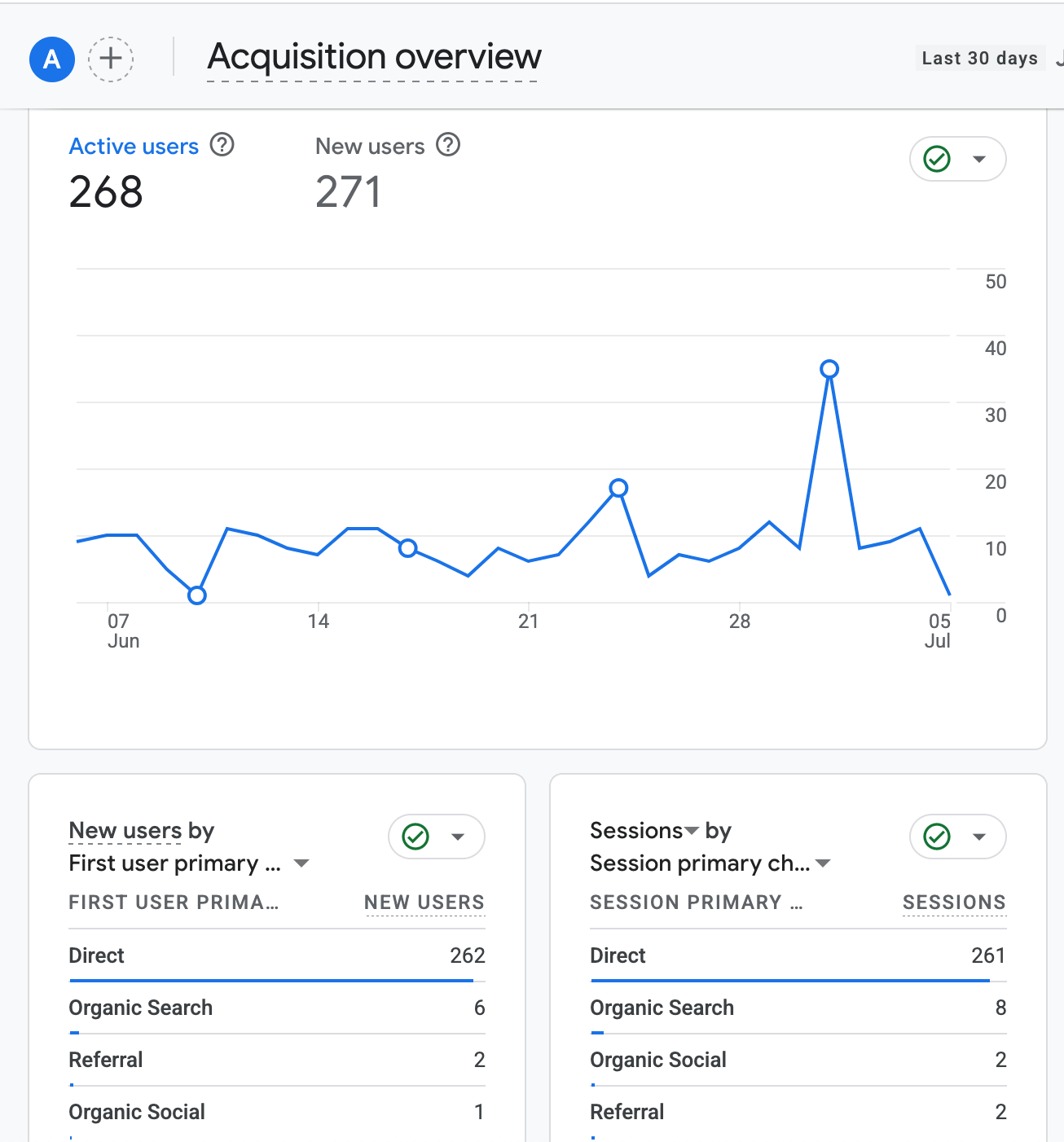
A screenshot from my Google Analytics on 6th July, 2026, showing the traffic over the previous 30 days. There’s a daily piddle of visitors, none of whom stick around for long.
My blogging plan for the next 6 months & what I’ll be paying attention to
Even in the best circumstances, blogging takes time to have an effect. I’ll stick with it for at least 6 months (the rest of 2026), with a check-in after 3 months (the end of September) to see if I need to adjust course in any way. I won’t make any major changes before then. I’ll share with you what turned out to be mistakes, as well as what seems to be working. However, I don’t expect to see anything meaningful — positive or negative — at the 3-month mark. I hope I have the beginning of good news by 6 months.
Traffic by itself is a vanity metric. It has no bearing on business results. I want to increase relevant traffic. Relevant traffic should have business benefits because then I can work on conversions. I don’t have a goal in terms of numbers because I honestly don’t know what’s realistic. There’s a lot of variation in how long it takes a site to have a significant increase in traffic, depending on a bunch of factors.
To attract relevant traffic, I’ll make sure my blog topics are relevant to potential clients who might be interested in my content marketing services, that the posts have internal links (which I’ll add over time as my website develops) and follow what I believe to be current good practices for both SEO and AI-search. This experiment actually falls into a category both Google and AI like: documented first-hand experience.
I’ll also be explicit about how I use AI in the process, and where I avoid it. That transparency is important to me.
I’ll also pay attention to keywords my site ranks for. According to Search Engine Land’s free rank checker, this are where my site currently ranks for some relevant keywords:
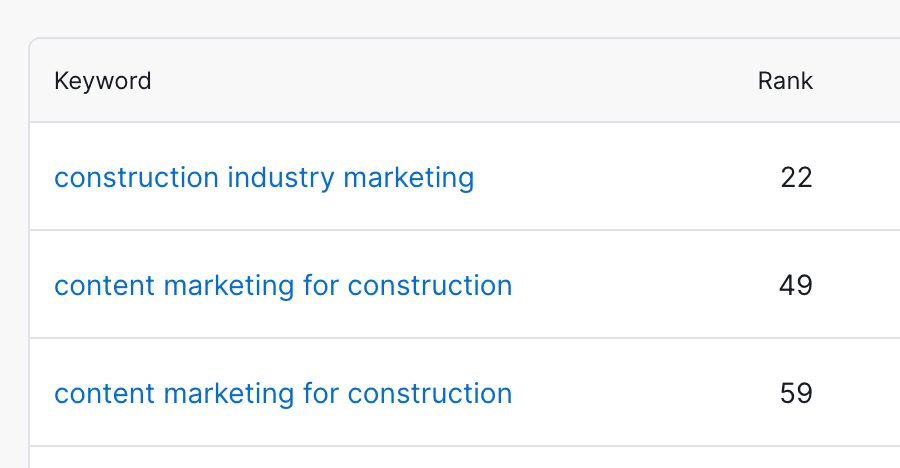
Don’t ask me why the same keyword is listed twice with different rankings 🤷♀️
I’ll also track sign-ups to my email newsletter and, of course — the most exciting part! — actual inquiries and bookings. I hereby promise to tell you all of them, even if they’re embarrassingly zero.
What this means for you, a business owner or consultant in the construction industry
As part of re-positioning my business, I’m offering a new service: Custom (AI-Assisted) Marketing Plans for business owners and consultants, so they can get more organic traffic, leads, and — ultimately — sales. In the past, my website hasn’t been a significant source of clients for me. I’ve gotten most of my freelance writing clients through a combination of referrals, LinkedIn, and cold outreach. I never bothered to put much effort into my website, so the poor, neglected thing never bothered to give me much in return.
What I learn from this experiment will help me give better advice to my clients. Potential clients will also see how I do and don’t use AI. If your website isn’t doing much for your business, this is the kind of problem my content marketing assessment is designed to diagnose — and help you fix. I’m walking the talk here.
P.S. How I used AI for this post
I wrote the first draft of this post myself. (I am a writer after all. Writing comes naturally.) I uploaded the draft to ChatGPT and gave it this prompt:
This is the draft of a blog post for my website. The point is to show over time that blogging can increase the traffic to my website. I want it to be a kind of case study for my clients for my new service for content marketing assessment/AI advisory. I don't want you to re-write it, but I'd like your suggestions for both how I can adjust the content to be more relevant to my potential clients and I'd also like keyword suggestions, given my goals of (a) increasing traffic and (b) appealing to potential clients. use the dataforseo tool. Ask me questions beforehand if necessary.Most of its advice was good — both for increasing relevance to my potential clients and also for reorganization — and I incorporated it into my draft. I also took some of its keyword suggestions. I then edited the post (a lot) before and during posting to my site.
If you’d like me to audit your content marketing, get in touch.
Until next time…